
How to Tell if Your Best Baseball Cards Need Authentication
When people find a strong card in an old box, they usually do one of two things too fast. They either assume it is real because it looks old, or they assume it needs grading because it looks valuable. Both mistakes can cost money.
The better move is slower and simpler. First, figure out whether the card needs authentication at all. Some cards do. Some do not. A few need authentication before grading. Some need a closer review before you spend a dollar on either step. That is where a lot of sellers get stuck, especially when they are sorting a mixed collection for the first time. If you are still working through the basics, our guides on what to do with old baseball cards, the 5-minute score test, and how to determine if your vintage cards are valuable can help you get organized first.
Why Your Best Baseball Cards Need Authentication Before You Guess at Value
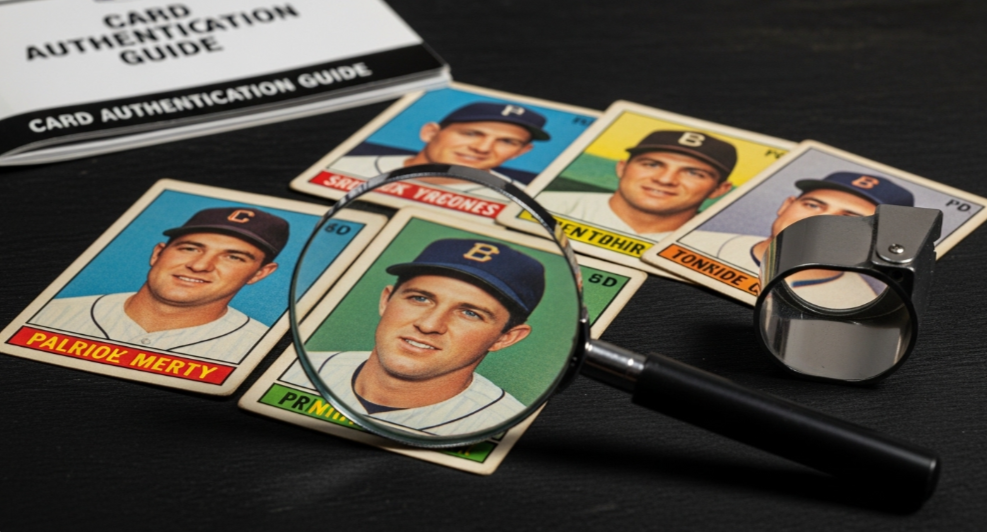
Not every card needs baseball card authentication. A lot of cards can be sorted, grouped, and priced at a basic level without sending them anywhere. But your best cards are different. The stronger the card, the more likely it is that authenticity, alteration risk, or buyer trust will matter.
That is especially true when the card is:
- vintage
- scarce
- signed
- from an uncertain source
- strong enough that a buyer will question it closely
- part of a collection you may sell privately or online
This is why we tell people not to jump straight into value questions. Before you ask what a card is worth, it helps to ask whether the card is original, whether it looks altered, and whether a buyer would want third-party confidence before moving forward. Our services page explains that we help people with pre-grading decisions, authenticity concerns, and collection reviews so they do not waste time or money on the wrong next step.
Baseball Card Authentication vs How Baseball Cards Are Graded
This is where confusion starts for a lot of sellers. How baseball cards are graded is not the same thing as how to authenticate baseball cards.
Authentication is about whether the card is real and whether it appears to be what it is supposed to be. Grading comes after that. Grading looks at condition, wear, corners, edges, surface, and centering. If the card has authenticity issues, alteration issues, or serious concerns before that point, the grading question becomes less important.
In plain terms, here is the difference:
- Authentication asks if the card is genuine
- Grading asks how strong the card’s condition is
- Authentication matters first when the card has risk
- Grading matters most when the card is already trusted as real
That is why people keep looking for where to get baseball cards graded may be asking the wrong first question. Sometimes the better question is whether the card even belongs in that line yet. Our Fairfax grading guide, true rookie card guide, and meeting sports card buyers page all point back to the same basic idea. Start with the card’s real risk, not with the submission form.
Red Flags That Mean You Should Authenticate Baseball Cards First
If you are trying to decide whether to authenticate baseball cards, start by asking which cards deserve extra suspicion. Most collections contain plenty of safe, ordinary material. The problem cards are the ones that are just strong enough, old enough, or unusual enough that mistakes get expensive.
A card deserves a closer look when:
- The stock, gloss, or texture feels wrong
- The edges look unusually sharp or oddly worked
- The color seems off compared with known examples
- The card looks altered, pressed, trimmed, or recolored
- The autograph seems questionable
- The card came from a source with no real history
- The card is important enough that a buyer will challenge it
This matters because sports card authentication is not something people pay for just to feel official. They do it because it removes doubt, where doubt can hurt the sale. If a card is raw, strong, and likely to attract questions, it is usually smarter to settle authenticity before you start negotiating value. If you are sorting a bigger group, our North Carolina page, Virginia page, and South Carolina page show the kind of vintage and pre-1975 material we usually help people review.
When How to Authenticate Signed Baseball Becomes a Separate Issue
Signed material changes the conversation. People often look for how to authenticate a signed baseball and assume the answer works the same way for cards. It does not.
A signed baseball, an autographed card, and an unsigned vintage card do not all carry the same risk. With signed items, you are not only asking whether the item itself is right. You are asking whether the signature is genuine, too. That can turn one question into two.
If your best piece is signed, slow down and look at:
- whether the item itself makes sense for the era
- whether the signature placement looks natural
- whether the ink and flow feel believable
- whether there is any real support behind it
- whether the signature adds enough value to justify the process
This is one reason we tell people not to lean too hard on weak paperwork or vague stories. A card can be real, and the autograph can still be wrong. Or the autograph can be real while the item itself still needs a better review. If signed material is part of a larger group, our pages on how to determine if your vintage cards are valuable and what to do with old baseball cards can help you sort what belongs in the high-priority pile.
Where to Authenticate Baseball Cards and Where to Get Baseball Cards Graded Depends on the Card
When people ask where to authenticate baseball cards, what they usually mean is this: what should I do with this specific card if I want buyers to trust it?
That answer depends on the card itself. A routine card may not need much. A scarcer vintage card may need more. A signed card with no strong backup may need an entirely different path. This is why the best baseball card authentication is a little misleading. There is no single best path for every card. There is only the best path for this card, in this condition, with this risk, and with this selling plan.
Before you make that choice, look at:
- How old is the card
- How much value may be at stake
- How easy it would be for a buyer to question it
- Whether it looks clearly original
- Whether grading would help more after authenticity is settled
- Whether it is part of a larger collection that changes the context
Our Ohio page, Tennessee page, and Indiana page all reflect the same practical approach we use elsewhere. We look at the full picture first, not just the one card someone is most excited about.
How Much Does It Cost to Authenticate a Baseball Card? Is Not the Best First Question
A lot of sellers jump straight to how much it costs to authenticate a baseball card. We understand why. Nobody wants to overspend. But cost by itself is not the smartest starting point.
A better question is this: Will authentication change the outcome enough to be worth it?
It usually makes more sense when:
- The card is valuable enough that doubt will hurt the sale
- The card is signed
- The card is vintage or scarce
- The card looks strong, but not fully convincing
- The card may be sold to a buyer who expects more proof
- The card has enough upside that a mistake would sting
If the card is common, low-risk, and unlikely to face serious scrutiny, the process may not add much. If the card is one of the strongest pieces in the collection, the math changes quickly. That is why our services page focuses so much on pre-grading, collection review, and helping people decide what deserves the extra step and what does not.
What We Need to See Before We Tell You How to Get a Baseball Card Authenticated
If you want a real answer to how to get a baseball card authenticated, we need more than a cropped front photo taken in poor light. The more complete the first look is, the better the advice will be.
Send us:
- a clear front photo
- a clear back photo
- close-ups of corners, edges, and surface
- the autograph area of the card is signed
- any slab or existing cert information
- a wider shot of the full collection, album, binder, or box
That last point matters. A lot of cards make more sense once we see what came with them. One strong vintage card next to related period material tells a different story than one strong card sitting alone with no context. Our contact page is the best place to start that conversation, and our meeting sports card buyers guide explains why bringing the full collection often works better than bringing only a small slice of it.
When We Think Best Baseball Card Authentication Really Matters
For us, the best baseball card authentication really means knowing when proof will protect the card, the price, and the selling process.
We push harder on authentication when the collection includes:
- strong vintage stars
- pre-1972 or pre-1975 material
- signed items with no reliable support
- cards that do not look clearly authentic baseball cards on first review
- scarce cards that will attract buyer questions
- cards where grading only makes sense after authenticity is settled
That is where a private review helps. We are not trying to turn every card into a long submission project. We are trying to help you decide what deserves a closer look, what belongs in the next-step pile, and what is better left alone. If that sounds like where you are right now, start with Baseball Card Roadshows or look through our blog for more collection-specific guidance.