
Is Your Baseball Card Collection Worth Anything? A 5-Minute “Yes/No” Checklist
If you are asking if baseball cards are worth anything, use this quick checklist first, then follow the proof steps right after it.
5-Minute “Yes/No” Checklist (Score It Fast)
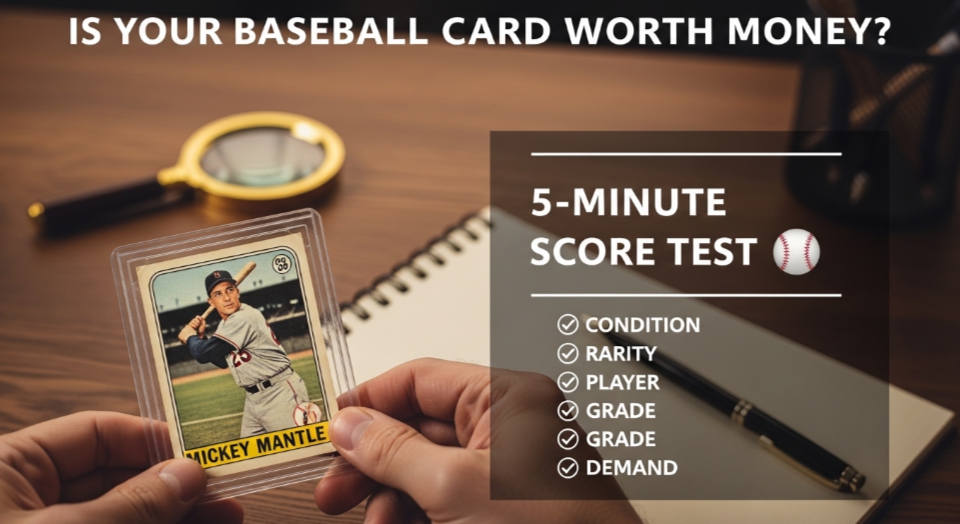
Give yourself 1 point for every “Yes.” If you hit 3 or more, your baseball card collection is worth a closer look, and you may have money for baseball cards in your home.
- Yes: You have cards from before 1972 (many people call these the value of old baseball cards or vintage baseball cards).
- Yes: You see big stars or Hall of Fame names you recognize.
- Yes: You have a rookie card (a player’s early-year card) of a star.
- Yes: Do you have any cards already in a hard plastic holder with a grade (that is graded vs raw)?
- Yes: You have cards that look “special” (shiny inserts, different colors, or serial numbers like 12/99).
- Yes: Your best cards look clean with strong condition (no creases, no heavy stains).
- Yes: The borders look even and not badly off-center (that is centering).
- Yes: The card corners are sharp (that is, corners).
- Yes: The sides are not frayed (that is edges).
10. Yes: The front and back are not scratched, dented, or sticky (that is, surface).
11. Yes: Your collection includes more than just one sport (baseball plus football, basketball, or hockey).
12. Yes: You have unopened packs or boxes.
If your score is 0 to 2, your collection can still have value, but it often falls into “bulk.” That does not mean worthless. It means you should confirm the value with the right steps instead of guessing.
Do People Still Collect Baseball Cards?
Do people still collect baseball cards? Yes. Many people still collect baseball cards, and demand is usually strongest for (1) key vintage cards, (2) star rookies, (3) scarce modern parallels, and (4) high-grade copies. The big question is not “collecting exists,” it is whether your specific baseball collection cards match what buyers are paying for today.
Step 1: Identify What You Actually Have (2 Minutes)
This is the fastest way to answer how to tell if a baseball card is worth money without sorting your whole house.
Do this quick sort:
- Make a “Pre-1972” pile (often the highest interest for old baseball cards worth).
- Make a “Stars/Rookies” pile (anything you recognize, any rookie card).
- Make an “Already graded” pile (slabs from PSA, SGC, or BGS).
- Make a “Special/rare-looking” pile (serial numbered, shiny inserts, odd sizes).
- Everything else goes to a “Bulk” pile (still sellable, just priced differently).
Simple rule: in most baseball card collections, the top value is concentrated in a small part of the box. If you find 10 to 30 strong cards quickly, you are already close to understanding how much baseball cards are worth in your collection.
Step 2: What Makes Baseball Cards Worth Money (The 4 Drivers)
When people ask what baseball cards are worth money, buyers usually price from these drivers:
1) Condition
Buyers pay more for cleaner cards. That is why condition is a core value component, and why issues like centering problems, soft corners, rough edges, and damaged surface change offers. PSA explains the same idea and points collectors to grading standards and their value tools.
2) Rarity
This is a baseball card rarity. Rarity can mean “hard to find,” “short printed,” “serial numbered,” or “scarce in high grade.” Two cards can be common in raw form but rare in top condition. This is a big part of the overall baseball card collection value.
3) Demand
Demand is: do buyers want it right now? A famous player, a key rookie, a popular set, and a hot team market all push demand.
4) Proof of recent sales
This is where most people get stuck, because a high asking price online is not proof. Real proof comes from recently sold prices.
Step 3: Prove Value With Real Sold Prices (The Part That Answers “What’s My Card Worth?”)

If you want to find the worth of baseball cards the right way, do not start with random listings. Start with solid data.
Reliable proof sources:
- PSA’s card value guide says, “Get started today to find over one million different trading card prices.”
- Card Ladder says they track “every public sale” in their database going back to 2000.
- SportsCardsPro says they track sports cards sold on eBay and combine those sold listings into one value by card and condition.
A simple comp method you can do in minutes:
- Search for the exact year, brand, player, and card number.
- Match the same grade if it is graded, or match the closest raw condition.
- Compare 3 to 10 recently sold results, not 1.
- Use the typical range, not the single highest sale.
This step answers how to find a baseball card’s value (for graded and raw), valuing baseball cards, and what baseball cards are worth with evidence instead of hope.
Step 4: Graded vs Raw, and When Grading Helps (Simple Rules)
Many sellers see “PSA 10” online and assume grading is always the move. It is not.
Plain meanings:
- Raw means the card is not graded; it is just the card.
- Grading means a company checked it and sealed it in a slab with a number score.
Grading helps most when:
- The card is already valuable in raw form.
- The card is clean enough to grade well (strong condition, good centering, sharp corners).
- The market pays a premium for that grade level.
Grading usually does not help when:
- The card has a crease, heavy stains, paper loss, or obvious damage.
- The card is a common from a heavily printed era.
- The grading fee is close to, or higher than, the card’s likely value.
These rules are the practical side of how to determine the value of baseball cards, because grading cost and likely grade are part of the real value.
Step 5: Are Baseball Cards Worth Anything Anymore? (What Most People Actually Have)
A lot of households have 1980s and 1990s cards. Many of those were printed in huge numbers, so a big box may still be mostly “bulk.” That is why people ask whether baseball cards are worth anything anymore.
Here is the honest answer:
- Many commons from that era are not high-dollar cards.
- But stars, key rookies, rare parallels, and high-grade copies can still be worth real money.
- Even bulk has a market if it is organized and the buyer can process it efficiently.
So yes, are baseball cards worth anything can be “yes,” but it depends on what is in your best pile, not how big the box is.
Get a Free Appraisal and Offer (Private, Simple, and Clear)
If you are actively looking for money for baseball cards, the fastest way to get clarity is a simple evaluation with good photos or a private appointment.
What to photograph (fast and useful)
- 10 to 20 best cards, front and back
- Any graded slabs (include the label)
- Any serial numbered cards (show the numbering)
- One wide photo of the full collection (boxes, binders, stacks)
What We Do at Baseball Card Roadshows
At Baseball Card Roadshows, we buy baseball, football, basketball, and hockey cards, graded or raw, from singles to full baseball card collections, and we keep the process private and straightforward.
Service areas we cover
If you want a free appraisal, contact us.
We regularly meet collectors across North Carolina, South Carolina, Tennessee, Kentucky, Virginia, West Virginia, Indiana, Pennsylvania, and Ohio.
If you scored 3 or more, you likely have something worth valuing properly. If you scored 0 to 2, you may still have sellable bulk, and we can tell you what it is realistically worth. Either way, you get a clear answer to what baseball cards are worth and a straightforward next step.