
How to Identify a Rookie Card When There Is No RC Logo
If you are sorting baseball rookie cards and you cannot find a rookie card logo, you are not alone. A lot of older sets never used an “RC” stamp, and some modern cards can look like rookies when they are not.
In this guide, we will keep it simple and practical:
- A quick answer for how to identify a rookie card
- A checklist you can use in real time
- The common traps that create “fake rookies.”
- A fast decision tree for any pile of baseball cards, rookies
- What to do next if you want to collect, buy, or sell
Rookie Card Without an RC Logo: The Quick Answer
A rookie card is usually the first mainstream card of a player after their MLB debut. The missing logo does not cancel that. It means you need to confirm the rookie year and the correct version using what is printed on the card.
Beginner’s rule for rookie card baseball:
- Match the card’s year to the player’s first year in the majors
- Prefer the most standard base set version
- Treat special versions as “extra,” unless you understand why they are scarce
Why Some Rookie Cards Have No RC Logo
Modern rookie logos became common later. Older baseball cards, rookie issues, especially before the mid 2000s, often relied on a hobby convention instead of a printed RC stamp. Around that same period, rookie designations became more standardized and more tied to whether a player had truly reached the big leagues.
What that means for you:
- Older rookie baseball cards usually require one extra step of checking
- You can still identify rookies accurately with a simple process
- The logo helps, but it is not the definition
The No-Logo Rookie Card Checklist
Use this checklist when you are sorting rookie sports cards, and you want a confident answer without getting dragged into internet arguments.
1) Confirm the set year and the brand
Look for the year and the set branding on the front or back. If you cannot find a printed year, write down the set name and the design style.
2) Find the card number
The card number is one of the best clues for verification. It helps you match the exact card to checklists, sales history, and other versions of the same player.
3) Decide if it is a base set or not
This step prevents most beginner mistakes.
- Base set cards share one main design and a single checklist numbering style
- An insert is a themed bonus card that has its own name and its own checklist
- A parallel is usually the same card number and photo as a base card, but with a different finish or color
If you are trying to build the best rookie cards baseball collection, most people start with base set rookies first and treat inserts and parallels as optional upgrades.
4) Check for “first major uniform” signals
For older players, the earliest widely released card showing the player in a major league uniform is often treated as the rookie by the market. That is why updated sets matter so much when there is no logo.
5) Match the rookie year to the player’s first MLB season
You do not need to memorize stats. You need the player’s first year in the majors and the card’s release year. If your card is clearly later, it is not the rookie, even if it looks like one.
Base Set vs Insert vs Parallel: Which One Counts as the Rookie?
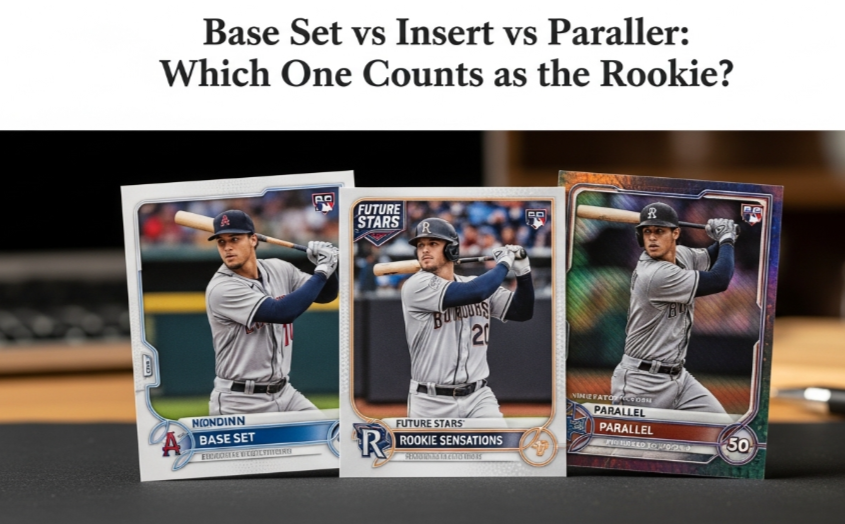
When people look for rookie cards to buy now, they often find three or ten versions of the same player from the same year. That does not mean there are ten equal rookies.
A practical way to think about baseball rookie card value:
- The base set rookie is usually the “main” rookie that most buyers recognize
- Parallels can be more valuable if they are truly scarce and in strong condition
- Inserts can be valuable, but many buyers do not treat them as the primary rookie
If you are selling, this matters because the base rookie often gets the widest buyer pool, while niche inserts can take longer to move.
Prospect Card vs Rookie Card vs First Card
This is the section that clears up the phrase the rookie sports cards confusion.
- A prospect card is made before the player becomes a full major leaguer
- A “first card” can mean the first card ever printed of the player in any context
- A rookie card is the first mainstream major-league era card that the market treats as the key early issue
A prospect card can still be valuable, but it is not always the rookie card that buyers mean when they ask for baseball card rookie versions.
Updated Sets: The Hidden Rookie Trap
If you are sorting older rookie baseball cards with no logo, you will see this pattern a lot:
- An updated release has the earliest major-league appearance
- A main set release has the later base rookie that everyone recognizes
Neither is automatically “wrong.” The key is knowing which one your buyer is asking for. If you are collecting, you may want both. If you are selling, you want to label them clearly and price them based on what the market actually buys.
Rookie Cup vs Rookie Card: Do Not Mix Them Up
Some baseball cards show a small trophy or cup symbol. That symbol is not the same thing as a rookie card logo.
Simple rule:
- The cup often appears on a later card as a recognition marker
- The baseball card rookie you want is still the first-year major-league issue
So do not upgrade a card to “rookie” status just because you see a cup.
60-Second Decision Tree for No-Logo Rookies
Use this when you are holding a rookie baseball card candidate, and you need a fast yes or no.
- Is the card from the player’s first MLB year, or the first major release right after?
- Yes: keep going
- No, it is likely a second-year card
- Is it a base set card?
- Yes: strong rookie candidate
- No: check if it is an insert or parallel
- Is there a traded card from that same rookie year?
- Yes: compare which one appears first in a major-league uniform
- No: the base card may be the main rookie
- Is the card in solid condition?
- Quick check: centering, corners, edges, and surface
What to Do After You Identify the Rookie
Once you know how to identify a rookie card, your next step depends on your goal.
If you are collecting:
- Start with the base rookie first, then learn the set
- Add parallels only when you understand scarcity and demand
- Protect rookies immediately, so you do not lose value from handling
If you are selling:
- Pull all rookies into one pile, then sort base cards away from inserts and parallels
- Keep the best cards in sleeves and top loaders
- Take clear front and back photos, plus closeups of corners and surface on your best pieces
If you want a simple refresher on what most collectors mean by “true rookie,” our true rookie card guide is here.
If you want more practical sorting and selling guides, our blog has more beginner posts.
Get a Clear Offer for Rookie Baseball Cards

If you have rookie sports cards or full baseball rookie card collections, and you want clarity, we can help without turning this into a complicated project. At Baseball Card Roadshows, we buy baseball, football, basketball, and hockey cards, graded or raw, from key singles to full collections, and we keep evaluations private and straightforward.
Here is the fastest way to help us evaluate:
- 10 to 20 photos of your best rookies, front and back
- Close-ups of corners and the surface of the top cards
- Any graded slabs, with labels visible
- One wide photo of the full collection, so we understand the era and size
You can start by reviewing our private appraisal and buying process, or request an offer.
We schedule one-on-one evaluations across North Carolina, South Carolina, Tennessee, Kentucky, Virginia, West Virginia, Indiana, Pennsylvania, and Ohio. If you want to see the tour footprint, our recently visited cities page shows where we have been.